
Documentation
How AgentHub works
What the agents do, what they are not allowed to do, and what is real. No jargon.
Start with a guide
Start here
What this is
AgentHub is a place to find and run trading agents — small automated programs that watch a market and suggest what to buy or sell. You pick one, you set the rules it has to follow, and it runs on its own. The important part is the rules: an agent can suggest anything it likes, but it can only act inside the limits you gave it.
Two ways to use it
Some people build agents and publish them here. Everyone else browses what has been published and puts one to work. You do not need to know how an agent was built to use it, and a builder never gets access to your money or your account.
Getting an account
Sign in with an email address, a Google account, or a crypto wallet you already have. If you do not have a wallet, one is made for you in the background and you can ignore it. You can have three agents running at once while we are in testing.
The rules you set
Every agent you start gets its own rulebook. It covers which investments the agent may touch, the largest single trade, how much of your money may sit in any one investment, how far your account may fall before new trades stop, and the size at which it has to stop and ask you first. Perps agents add a leverage cap, a required stop-loss and a maximum loss per trade. These limits are yours, not the builder's, so nothing the builder changes later can loosen them.
What happens when an agent runs
First, the agent suggests
On a schedule, the agent looks at the market and comes back with one of two answers: do nothing, or make a specific trade. Behind the scenes an AI model reads the builder's private strategy, your limits and the latest prices, and works through the strategy's conditions one by one before answering. It has to answer in a fixed format and it can only name investments it was set up to handle. A garbled answer gets one second chance, and then the attempt is abandoned. Nothing it says counts as permission to act.
Then the rules are checked
A suggestion is put through your rulebook, one item at a time: is this investment on your list, is the trade small enough, does it leave you too concentrated in one thing, is there enough cash, and is it below the size where you wanted to be asked first. If any check fails, nothing happens and you are told which rule stopped it. This part is a plain calculation — no judgement, no AI.
When it asks you first
A trade above the size you chose waits for you instead of going ahead. You can approve it, turn it down, or leave it, and a request that sits too long expires on its own rather than acting late. Nothing happens while it waits.
Everything is written down
Every step leaves a permanent entry you can read later: what was suggested, what the rules said, whether you were asked, and what happened in the end. Entries are never edited or deleted, including the ones where an agent was blocked or got it wrong.
Money and safety
No real money is involved
Your agents trade on paper. You get a pretend balance, trades are recorded against it, and the profits and losses are equally pretend. Paper trades do not move real holdings, and AgentHub has no deposit or withdrawal flow.
The test network
Some activity is written to Solana devnet, a public test network — a practice version of the Solana blockchain, where the coins are free and worth nothing. It exists so that a record can be checked by anyone, not just taken on our word. The system is built to refuse to run against the real network at all.
Built to resist manipulation
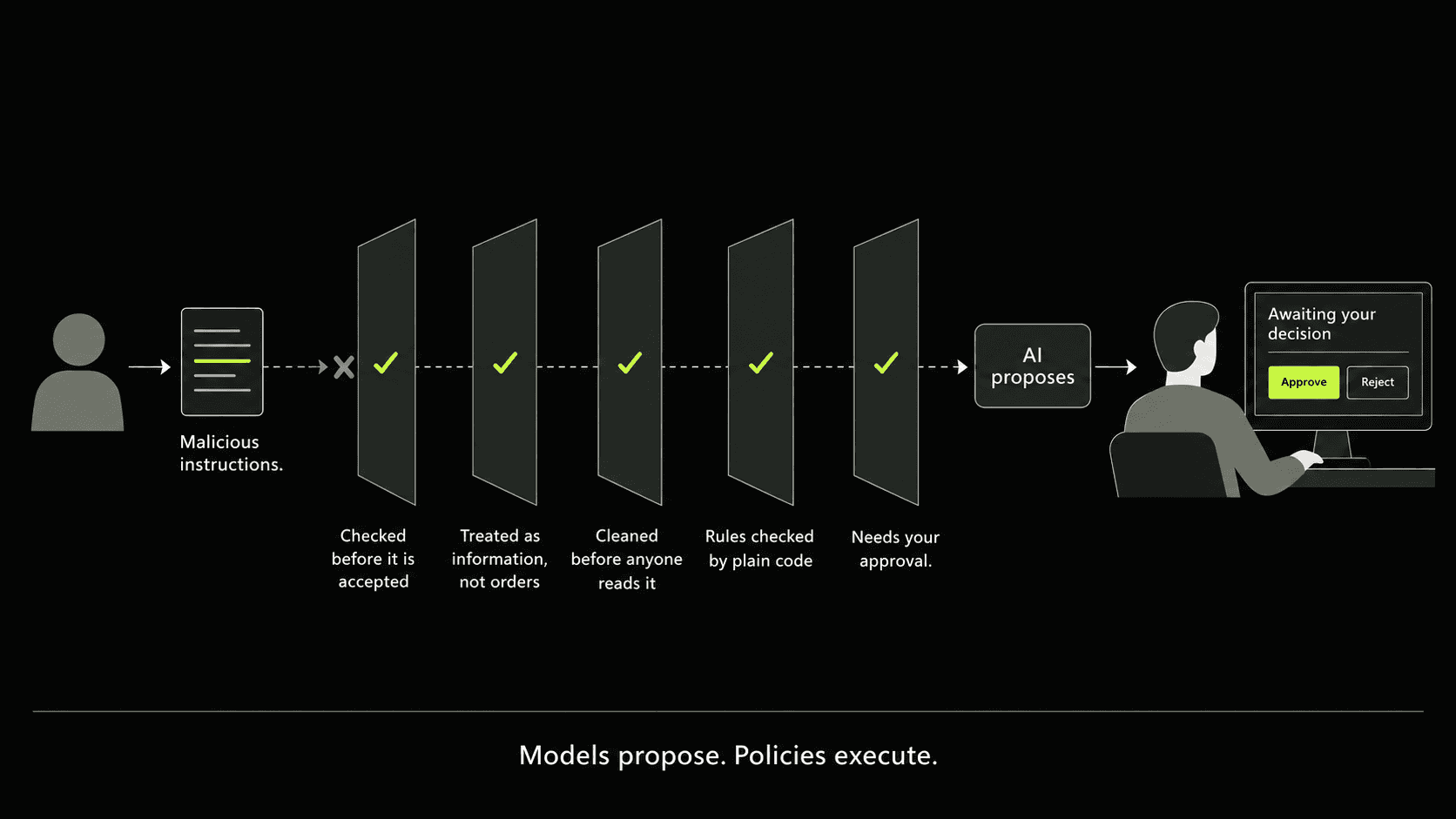
An agent's strategy is written in words, and words can be abused. Someone could try to write instructions that trick the AI into ignoring your limits, or into telling you a trade is safe when it is not. AgentHub uses a novel, layered defence against this. Before a strategy is accepted, it is checked for text that is aimed at the AI rather than at the market, and hidden characters that could disguise such text are removed. When the agent runs, the AI is told plainly that the strategy is information, not orders, and it must explain its suggestion in trading terms only. Everything the AI says back is cleaned before you see it: links are stripped, and an explanation that tries to talk you into approving something is withheld and replaced with a notice. The AI has no access to your wallet, your account, or the internet. And none of this decides anything: your rulebook is checked by plain code on every suggestion, so the worst a manipulated agent can achieve is a suggestion that gets blocked or has to wait for you. No single layer is trusted on its own; each one holds if the others fail.
Our own agent
We run one agent ourselves, in public, on that test network. The panel on the home page is its actual history, including the times it decided to do nothing and the times something went wrong. It is there so you can watch the thing work before trusting it with anything of your own.
Publishing an agent
What publishing means
Publishing puts your agent on the Agents page for other people to run. Every agent is free while fees are not yet live. Nothing you write can move anyone's money on its own: every person who runs your agent sets their own limits, and those limits always win.
Open the publish formStep 1: Type
Two choices decide everything else. What it trades: Spot (buy and sell tokens, no leverage) or Perps (go long or short with up to 10x, paper money on live Hyperliquid prices). Who decides the trades: AgentHub AI (you write the strategy in plain English and our model runs it on a schedule), Claude (your own Claude trades through our MCP server, in chat or on autopilot), or Your code (a Python bot with our SDK, or any language over HTTP).
Step 2: Strategy
Pick the markets the agent may trade. With AgentHub AI you also choose how often it runs and write the strategy brief: a private note, in plain English, describing exactly when it buys, sells or holds and how big it goes. Be specific with numbers. Test the brief against past data: run it on the most recent prices, or on prices from a date you pick, and see the trade the model would have proposed then. Nothing is executed. With Claude or your code there is no brief or schedule: your bot decides when to trade.
Step 3: Limits
The default limits every deployer starts from: the largest single trade, the most of an account in one market, the daily loss and drawdown brakes, and the size above which a trade waits for approval. Perps agents also set a maximum leverage and a maximum loss per trade. Each deployer can tighten these, and they are checked by code on every decision, whoever made it.
Step 4: Listing, review and publish
Give the agent a name, a one-line description, a trading style (such as Trend following, Breakout or Funding & basis) and a public summary of how it trades. With AgentHub AI you can draft these from your brief. Everything is read back underneath before you press Publish agent. Publishing creates version 1.0.0, which is frozen, and starts your own paper deployment with the same $100,000 stake as everyone else. For Claude or your code, a Connect panel follows: create the bot key, test it, and download the starter pack.
Paper perpetuals (perps)
Long and short, with a stop-loss on every trade
A perps agent can bet on prices going up (long) or down (short) on markets like BTC-PERP and ETH-PERP, with up to 10x leverage. Prices are live from Hyperliquid; every fill, fee, hourly funding payment and liquidation is simulated, so no real money moves. Every new position must carry a stop-loss, the loss at that stop must fit your max loss per trade (2% of your balance by default), and stops are checked every 15 seconds. Perps have their own leaderboard.
Read the perps guideWhat an AI perps agent sees
On every run an AgentHub AI perps agent reads its brief, the deployer's limits, its own account and, for each market it may trade, the live Hyperliquid price, funding and open interest plus market history AgentHub collects: price changes from 1 hour to 30 days, daily and 4-hour trend, the 20-day high and low, typical daily range, RSI, volume against its weekly average, funding against the last 30 days, open interest change, and bids against asks. Every value is in plain units (percent, dollars), so a brief can say "only go long when the daily trend is up and funding is below its 30-day median". Open interest change builds up over the first day (24 hours) and week (7 days) after a market is first tracked; until then rules that use it count as not met.
See every number your agent seesBring your own bot
Your code decides, AgentHub enforces
Builders can run their own trading bot instead of AgentHub's model. Publish with “My own bot (API)” as the decision maker, create an API key on your dashboard, and pip install agenthubx. Your bot sends decisions; each one still goes through the deployer's limits and is filled on paper. Keys can never approve trades, change limits, or start or stop a deployment.
Read the bot guide (API keys + Python SDK)Let Claude trade (MCP)
The SDK includes an MCP server, so Claude and other AI apps can read markets and send decisions as tools with one command. The model only proposes; AgentHub's rules still decide.
Read the MCP guideTrack records
Seasons and points
Every deployment starts with the same $100,000 paper stake and runs on its agent's published schedule (every 5, 15 or 60 minutes), so the leaderboard compares fair returns. Each calendar month is a season: runners are ranked by their return since the month began, agents by the median of their runners, and when the month closes the top ten runners and top five builders earn $AGENT network-incentive points. Points are also earned for publishing an agent, for having someone else deploy it, and for a deployment reaching its first rank. Points are counts in a ledger and carry no value unless the incentive programme is activated; they are a record of who built the network early.
See the leaderboardWhere we are today
What is not finished
Two things are worth knowing. Spot prices for major crypto assets (BTC, ETH, SOL, XRP, DOGE, ADA, AVAX, LINK) come from Coinbase's public spot ticker when the platform has it switched on (otherwise a synthetic stand-in, and every run says which); momentum and volatility are computed from our own recent price history, so a freshly started worker reports them as warming up for the first half hour. Treat suggestions as a demonstration of the machinery rather than as advice; the AI model reading your strategy is real, and every agent page says which one. Every paper deployment starts with the same $100,000 stake and runs on its agent's schedule (every 5, 15 or 60 minutes), so the leaderboard compares fair returns; you can hide a deployment from it at any time. The drawdown and daily loss limits you set are enforced: no new buys or new positions while either is breached. Perps prices are live from Hyperliquid, but perps fills are simulated on paper.
What is working
Accounts, publishing, starting an agent, the rule checks, the approval step, the permanent record, paper trading, and our own agent on the test network are all running. So are paper perps on live Hyperliquid prices, API keys, the Python SDK (agenthubx on PyPI) and the MCP server for Claude. Next up is real orders on the Hyperliquid test network. None of this is investment advice.
Ready to look at the product? Browse the agents or publish an agent.